
SHARE
How to Compare Outsourcing Destinations: A 5-Factor Framework

Outsourcing has come a long way from being a cost-saving tactic to becoming a strategic growth lever for global businesses. Today, companies are building full-scale tech, design, and finance teams offshore, accessing world-class talent while staying agile and competitive.

But with so many options available, from the Philippines and India to Sri Lanka, Egypt, and other emerging hubs, how do you decide which destination best suits your business?

The truth is, there’s no single “best” outsourcing country. Each location offers unique strengths and trade-offs. The key is understanding what matters most to your business and using a clear framework to make an informed decision.

Here’s a practical five-factor framework to help you compare outsourcing destinations and find the one that fits your goals.

1. Understanding the real cost of outsourcing

Cost is usually the first thing businesses look at when exploring outsourcing, but it’s also where many underestimate the hidden details. Comparing hourly or monthly rates alone doesn’t paint the full picture. What truly matters is the total cost of ownership and everything it takes to build and maintain your offshore team.

That includes:

  • Salaries and benefits
  • Office or workspace setup
  • Internet, hardware, and tools
  • Management overhead and coordination
  • Training and onboarding
  • Travel, compliance, and exchange rate factors

A destination that looks inexpensive on paper can end up costing more once you factor in infrastructure limitations, time zone inefficiencies, or high turnover. On the other hand, markets like the Philippines and India offer a balance of competitive labour rates and mature outsourcing ecosystems, which means less friction and more value for every dollar spent.

It’s also worth remembering that ‘cheap’ talent can quickly become expensive if quality or productivity suffers. A reliable partner can help you strike the right balance between cost and capability, not just cost and headcount.
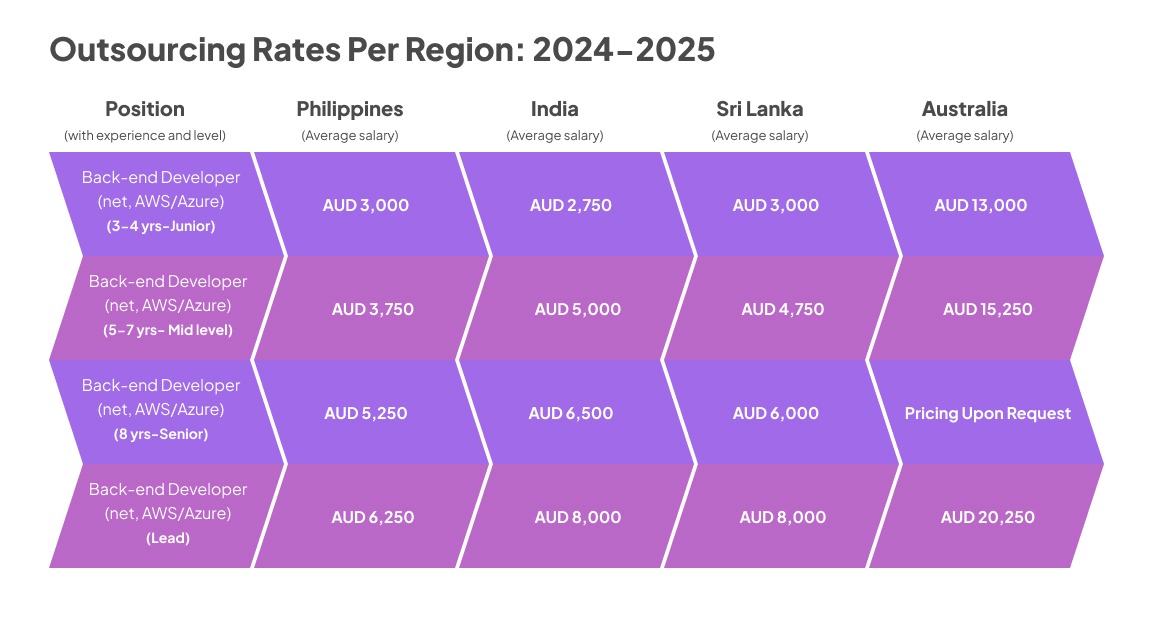
Source: Comparing Outsourcing Costs Across the Globe (Teamified)

If you’re comparing locations like Australia, the Philippines, India, and Sri Lanka, Teamified’s outsourcing guide offers a transparent look at average compensation ranges across roles and countries. Check it out, as it is a helpful starting point for understanding what you’re really paying for.

2. Finding the right skills in the right market

Strong outsourcing partnerships start with the right people. The size, diversity, and quality of a country’s talent pool directly affect how well your offshore team performs, not just in technical ability, but also in creativity, adaptability and collaboration.

Ask yourself:

  • How deep is the local talent market for your specific needs (software, UX/UI, finance, digital marketing)?
  • What’s the level of technical proficiency and English fluency?
  • Are there strong education and training systems feeding skilled graduates into the market?

India remains a global leader in IT, software development, and data analytics, producing millions of skilled STEM graduates every year with strong English fluency and technical depth.

The Philippines, meanwhile, is known for its creative and customer-focused professionals who excel in digital marketing, design, and back-office services, supported by excellent communication skills and a strong understanding of international business culture.

Sri Lanka is gaining ground as a niche outsourcing hub for finance, HR, and IT, offering a smaller but highly skilled workforce known for precision, professionalism, and cost efficiency.

Together, these destinations give businesses access to a wide spectrum of global talent, from large-scale technical expertise to customer-centric and specialised roles.

3. Infrastructure, connectivity and readiness

No matter how talented a team is, they can only perform as well as the systems that support them. When choosing where to outsource, look at how reliable and ready each country’s infrastructure really is, from connectivity and power supply to data protection and office quality.

Digital reliability matters most: stable internet, secure cloud access, and strong cybersecurity are now baseline expectations for global operations. But physical factors still count. Dependable power, modern workspaces, and accessible transport links can make or break day-to-day efficiency. It’s also worth checking how each country handles data privacy and compliance . The smoother the local regulations, the easier it is to operate confidently across borders.

Countries like India and the Philippines have long invested in their outsourcing ecosystems, offering modern IT parks, robust connectivity, and government-backed support for the tech sector. Sri Lanka, while newer to the scene, is catching up fast with ongoing upgrades to its digital infrastructure and growing clusters of IT hubs in major cities.

Simply put, solid infrastructure gives your offshore team the foundation to deliver consistent, high-quality work without the downtime or disruption.

4. Scalability and long-term growth

Outsourcing works best when it gives you space to grow. The right destination shouldn’t just meet your current needs – it should make it easy to add new people, departments, or functions as your business expands.

Scalability depends on a few practical factors: how flexible the local labour market is, how quickly you can hire and train new talent, and how supportive the business environment is when you scale operations. Incentives, tax benefits and an active ecosystem of vendors and training providers can all make growth smoother and more predictable.

India sets the standard for large-scale expansion, supported by decades of outsourcing experience, a deep talent pool, and mature industry networks.

The Philippines stands out for its adaptable workforce and supportive labour regulations, which make it easier for businesses to grow teams quickly without excessive bureaucracy.

Sri Lanka, while smaller, offers steady, quality-driven growth – ideal for companies focused on building lean but high-performing teams. Choosing a destination that supports growth helps your offshore strategy grow with you.

5. Communication and cultural alignment

Good communication is what keeps global teams working in sync. Even with the right systems and processes, projects run more smoothly when people understand each other’s work habits, tone, and expectations.

The Philippines is one of the most culturally aligned destinations for international businesses. The country consistently ranks among the top in Asia for English language skills, placing 22nd out of 111 countries globally in the EF English Proficiency Index. Filipino professionals bring a friendly, empathetic, and adaptable communication style that fits naturally into customer-facing, creative, and collaborative roles.

India brings a structured, process-oriented approach that works well for technical and project-based teams. Indian professionals are used to working across time zones and managing complex workflows, which makes collaboration with global tech and IT clients efficient and predictable.

Sri Lanka sits somewhere in between – its workforce is English-proficient, respectful in communication, and known for attention to detail. It makes collaboration easier and builds trust over time.

Top outsourcing destinations to consider

While cost, talent, and scalability matter, choosing where to outsource can shape the entire outcome of your strategy. Here’s a closer look at three of the most trusted outsourcing destinations, and what makes them stand out.

Philippines as a global leader in customer experience and creative talent

The Philippines remains one of the best countries for outsourcing, particularly for customer support, digital marketing, and design. Known for high English proficiency and a service-oriented culture, Filipino professionals are recognised for their empathy, adaptability, and reliability.

The outsourcing industry contributes 8.7% to the country’s gross domestic product (GDP) and is expanding into high-value roles like software development, animation, and UX design, supported by modern IT parks and government initiatives.

India as the innovation hub for tech and IT services

India continues to dominate the global outsourcing market, driven by its vast pool of engineering and IT talent. With established tech ecosystems in Bangalore, Hyderabad, and Pune, India offers deep expertise in software development, AI, data analytics, and cloud technology.

Its long history in enterprise outsourcing and strong project management culture make it ideal for companies that need scale and technical depth without compromising quality.

Sri Lanka as an emerging destination for high-value outsourcing

Meanwhile, Sri Lanka is emerging as a promising destination for high-value outsourcing. Its educated, English-speaking workforce excels in finance, HR, and IT services, while time-zone alignment with Australia makes collaboration seamless.

With improving digital infrastructure and competitive costs, Sri Lanka is becoming a smart choice for companies looking to build smaller, high-performing teams that deliver dependable results.

What this looks like in practice

To see how the right outsourcing destination can drive real business growth, take Infuse Marketing , a Melbourne-based marketing agency working with some of Australia’s fastest-growing brands in construction, finance, and food and beverage.

To keep pace with their expanding client base, Infuse partnered with Teamified to build an offshore team in the Philippines. Their new hires, including a digital marketing expert, SEO specialists and digital advertising professionals, helped extend the agency’s capabilities across strategy, execution, and campaign support.

Since expanding offshore, Infuse Marketing has achieved stronger campaign results, faster turnaround times, and greater capacity to take on new clients. Their Filipino team now plays an active role across digital channels and content initiatives, helping Infuse deliver more consistent, high-quality marketing outcomes for their clients.

Choosing the right destination with Teamified

Every business outsources for different reasons: to access specialised talent, speed up growth, or make operations more efficient. The challenge is finding a destination that fits your strategy, not just your cost targets.

Teamified helps businesses make that call with confidence. We’ve built teams across the Philippines, India, and Sri Lanka, and we understand how each market works, from the Philippines’ strong cultural fit to India’s depth of technical expertise to Sri Lanka’s growing base of finance and IT professionals.

Our goal is simple: to help you choose the right location, build the right team, and see results faster.

Curious to know which destination fits your business best? Talk to us today for a free quote and a clearer picture of where your next team should be.

About The Author

Simon Jones
DSC01347
Simon has over 20 years of experience in technology, cloud architecture, and business transformation, with a strong focus on building scalable solutions and high-performing teams.

As the Co-Founder of Teamified, Simon helps businesses expand their onshore operations quickly and cost-effectively by leveraging global talent. His expertise in fintech, SaaS, and IT infrastructure enables him to design outsourcing strategies that drive operational efficiency and business growth.

Before Teamified, Simon co-founded Assembly Payments and held leadership roles across multiple technology-driven organisations. His deep knowledge of cloud computing, automation, and system architecture has positioned him as a trusted advisor to businesses seeking to optimise their workforce and technology stack.