



Offshore accounting is the practice of shifting some or all of your business’s accounting functions to a team located outside your home country, typically one where the cost of labour is significantly lower. Instead of relying solely on an in-house finance department, businesses partner with skilled accountants overseas who manage everything from day-to-day bookkeeping to complex financial analysis and reporting.
Offshore accountants can act as an extension of your finance function, providing the same visibility, accuracy, and quality you’d expect from your in-house team.
Every successful outsourcing journey begins with clarity. Before you even start building an offshore accounting team, it’s important to define why you’re making the move. Too often, businesses rush into outsourcing with “cost savings” as the only driver, but in reality, cost is just one piece of the picture.
Ask yourself what you want your offshore team to achieve:
Being clear on your priorities will shape everything from the roles you outsource first to the offshore model you choose. It will also help you measure success in terms of business outcomes — not just reduced costs, but stronger compliance, improved efficiency, and better strategic decision-making.

Once you’ve mapped out your goals, the next step is deciding which roles to outsource first. Not every task should be moved offshore immediately. A phased approach works best because it reduces risk, builds trust, and allows your in-house and offshore teams to adapt gradually.
When building an offshore team, most businesses begin with transactional tasks - the high-volume, process-driven activities that take up time but don’t require constant face-to-face interaction:
Once workflows are established and communication flows smoothly, businesses often expand to higher-value roles that bring more strategic impact:
This phased progression ensures you expand capability and bring in the right skills in the right order. Instead, you build confidence step by step, moving from transactional to strategic tasks as the partnership matures.
Once you’ve defined your goals, the next step is to select the outsourcing model that best fits your needs. The right model can make all the difference in how smooth your transition is and how much value your offshore accountants deliver.
Here are the three main models to consider:
1. Staff augmentation
Use this model when:
Example: A Sydney-based retailer hires an offshore accountant to support month-end reconciliations during the busy holiday season, freeing up local staff for inventory and cash flow management.
2. Dedicated teams
Use this model when:
Example: A mid-sized Melbourne-based construction company builds a dedicated offshore accounting team to handle bookkeeping, payroll, and management reporting, while its local CFO focuses on project financing and strategic planning.
3. Full-service outsourcing
Use this model when:
Example: A Perth-based SME with limited finance staff outsources its entire payroll and compliance function to an outsourcing provider, ensuring accuracy, security, and compliance with both Australian and international regulations.
Here’s a quick breakdown of the three outsourcing models to help you decide which setup makes the most sense for your accounting function.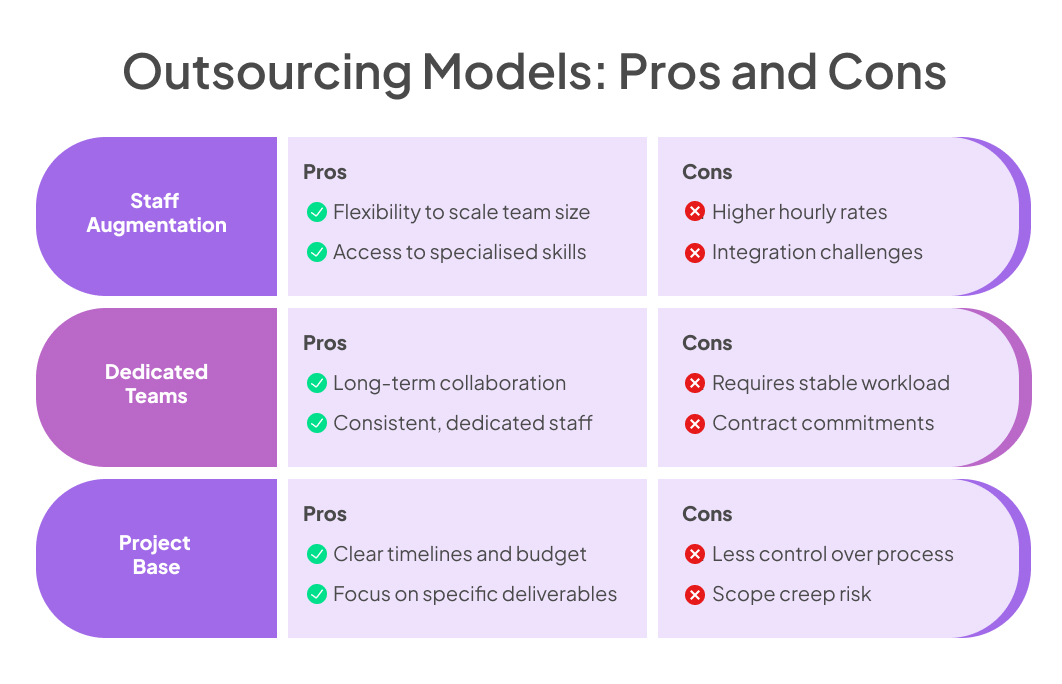
By weighing these options against your goals, you’ll be able to choose an approach that not only fits your budget but also supports long-term efficiency and business growth.
Create a roadmap for a smooth transition
Shifting your accounting function offshore isn’t something that happens overnight — it’s a staged process that requires planning and patience. The most successful transitions follow a clear roadmap that strikes a balance between speed and stability. Rushing the process often leads to confusion, errors, and disengagement, while a thoughtful rollout builds trust and long-term confidence.
Here’s what a solid transition roadmap should include:
1. Knowledge transfer
Start by documenting your existing workflows, processes, and reporting cycles. The more detail you provide, the easier it is for your offshore accountants to integrate seamlessly into your operations.
2. Training and alignment
Invest time in ensuring your offshore team is not only trained on your systems and tools but also aligned with your business values, culture, and expectations.
3. Pilot projects
Begin with smaller, lower-risk tasks such as bookkeeping or reconciliations. These serve as a testing ground for communication, accuracy, and efficiency before expanding the scope.
4. Gradual scaling
Once confidence is established, incrementally move higher-value tasks offshore — from AP/AR to management reporting, then eventually financial planning and analysis, or tax preparation.
Invest in the right tools to stay connected
One of the biggest concerns leaders have when building an offshore team is whether they’ll lose visibility and control. It’s a fair concern. If your team is on the other side of the world, how do you keep track of progress, make sure deadlines are met, and maintain the same level of quality?
This is where tools make all the difference. While your transition roadmap outlines how to move tasks offshore, your tools ensure the relationship works smoothly on a day-to-day basis. With the right setup, your offshore accountants will feel like they’re sitting just a few desks away, even if they’re in another country.
A few essentials to consider:
When implemented properly, these tools bridge the physical distance between in-house and offshore employees. The result is not only operational efficiency but also cultural alignment and stronger team engagement.
Prioritise data security and compliance
When it comes to finance, trust is everything, and that trust hinges on how well your business protects data and meets compliance obligations. Financial data is highly sensitive, which means that even a single lapse can result in legal consequences, financial penalties, or reputational damage.
For this reason, data security and compliance must sit at the core of your offshoring strategy.
Ensuring offshore teams adhere to the same quality standards as your local team can be challenging. That’s why regular training, monitoring, and quality assurance checks are crucial for maintaining consistency across jurisdictions. It’s not enough for an offshore partner to claim compliance — they must demonstrate it through established frameworks, certifications, and transparent processes.
When outsourcing accounting, make sure your partner:

References:
[1] Where Have All the Accountants Gone? Accountant Shortage in Australia (remotestaff.com.au)
[2] The Ultimate Guide to Offshore Accounting (toaglobal.com)
[3] Building a Reliable Offshore Accounting Team: Step-by-Step Guide (thefinopartners.com)
[4] Offshoring Accounting Functions and How to Make it Work (aswhiteglobal.com)