

Marketing is the growth engine for every business - driving demand, building brand awareness, and accelerating sales. Yet for many SMEs, scaling a marketing team in-house can be expensive and slow, especially when every role from SEO to social media management requires specialised skills.
It’s no surprise that businesses are turning to outsourcing to bridge the gap. In fact, the global market for outsourced sales and marketing is forecast to grow by over 9% every year through 2030, showing just how effective and popular this approach has become.
An offshore marketing team lets you access skilled talent at a fraction of local hiring costs while giving your in-house team the freedom to focus on strategy and growth. Done right, it becomes a seamless extension of your business.
If you’re ready to explore outsourcing, here’s a step-by-step guide to building an offshore marketing team that drives results.
Before you bring on your first offshore team member, clarity is everything. Outsourcing without a plan can lead to mismatched hires and wasted resources. Begin by defining exactly what you want your marketing team to achieve. Ask yourself:
Your answers will shape the size, structure, and skill set of your offshore marketing team. For example, a business aiming to dominate organic search will need SEO specialists and content writers, while one focused on lead generation might prioritise paid ads and marketing automation.
In order to build the right team, clear strategy ensures that every role you hire contributes directly to your growth goals.
Not every marketing task needs to remain in-house. Many SMEs keep strategy and brand direction internal while leveraging offshore teams for execution and production. This approach allows you to scale campaigns faster, reduce costs, and focus internal resources on higher-level decision-making.
Certain marketing functions are especially well-suited for outsourcing because they are process-driven, measurable, and can be managed effectively by remote specialists. Here’s a breakdown of common roles you can offshore:
| Marketing function | Roles you can offshore | Why offshore these roles? |
|---|---|---|
| Content and SEO | Content writers, SEO specialists, link-building experts | To keep blogs, website copy, and search rankings active |
| Social media | Social media managers, content creators, analysts | For engagement, community management, and visual content |
| Paid advertising (PPC/Performance) | Digital marketing specialists, ad campaign managers, ad copywriters, performance analysts | To manage and optimise campaigns across Google and social |
| Email and marketing automation | Email marketers, CRM specialists, automation experts | For newsletters, nurture flows, and campaign execution |
| Design and multimedia | Graphic designers, video editors, motion graphics specialists, UX/UI designers | To produce visuals, social creatives, and multimedia |
Outsourcing these roles to experienced offshore professionals allows your local team to focus on strategy and growth. Instead of getting caught up in day-to-day execution, they can concentrate on shaping campaigns, analysing performance, and driving results, while every marketing channel continues to run seamlessly in the background.
How you build your offshore marketing team has a direct impact on your results. The right model depends on your goals, budget, and how hands-on you want to be with day-to-day marketing execution. Here are the three most common approaches:
1. Freelancers and contractors
Freelancers are a practical choice when you need short-term support or specialised skills without the commitment of a full-time hire. Maybe it’s a designer to create a batch of ad creatives or a copywriter to refresh your website. This approach keeps costs flexible, but managing multiple freelancers and maintaining consistency can be a challenge.
2. Marketing agencies
Agencies are best suited if you want a team that can handle everything from strategy to execution. They can manage your paid ads, SEO, content, and email campaigns, often providing structured reporting along the way. While convenient, agencies usually come with higher costs and can feel less connected to your internal team and brand culture.
3. Dedicated offshore teams through an outsourcing partner
For businesses looking to scale marketing in a more sustainable way, a dedicated offshore team offers the control of an in-house team at a fraction of the cost. Your offshore specialists work exclusively for your business, follow your processes, and become familiar with your brand without the overhead of local hiring. This model is ideal for companies running ongoing campaigns and wanting consistency over the long term.
| Model | Best for | Pros | Cons |
|---|---|---|---|
| Freelancers and contractors | Short-term projects, filling skill gaps quickly | • Flexible and affordable • Access to niche expertise on demand |
• Harder to manage multiple freelancers • Inconsistent availability and quality • Limited brand alignment |
| Marketing agencies | Businesses wanting full-service support with minimal internal management | • Wide range of marketing services • Structured processes and reporting • Can scale campaigns quickly |
• Often expensive with fixed monthly fees • Less integrated with your team • Limited control over daily execution |
| Dedicated offshore teams | Companies ready to scale marketing long-term with control and cost-efficiency | • Consistent, reliable team aligned with your brand • Up to 70% cost savings vs local hires • Easier to manage than multiple freelancers or agencies |
• Requires upfront onboarding • Best suited for ongoing marketing needs rather than ad hoc projects |
Most first-time outsourcers start with freelancers or agencies to “test the waters,” but businesses that see serious growth often transition to dedicated offshore teams. This model gives you the reliability of an in-house team, with the scalability and cost benefits of outsourcing, making it the strongest option for long-term marketing success.
If you’re weighing whether to hire freelancers or build an offshore team, our blog ‘Offshore talent vs. freelancers: what’s best for your business’ breaks down the differences and helps you choose the right model.
Pick the right location for your offshore team
Where you build your offshore team can make a big difference in cost, quality, and how smoothly your team collaborates day-to-day. Different regions specialise in different strengths, and understanding these can help you build a team that complements your in-house capabilities.
Philippines
Highly regarded for its excellent English proficiency and creative talent pool. If your marketing relies on content creation, social media engagement, customer marketing, or visual design, the Philippines offers professionals who understand international markets and can align closely with your brand’s tone and style.
Read more: Outsourcing to the Philippines: What every business should know
India
Well-known for its depth of talent in technical marketing and performance roles. From SEO and analytics to paid ads and marketing automation, India offers access to highly skilled specialists at competitive rates. Many businesses also value India’s long experience in collaborating with international teams.
Read more: Why Outsourcing to India Still Makes Business Sense in 2025
An emerging hub for marketing support and digital operations, offering cost-effective solutions without compromising quality. Sri Lanka is ideal for businesses looking to build teams for content support, market research, and back-end digital tasks, with growing availability of skilled talent.
When deciding where to build your team, consider:
Offshore doesn’t have to mean off track, but without the right systems in place, businesses can face common challenges like miscommunication, inconsistent output, and delayed approvals. Time zone differences, cultural gaps, and lack of direct oversight can also impact how campaigns perform.
Here’s how to keep your offshore team aligned and performing at its best:
1. Set clear expectations from day one
Define roles, KPIs, and workflows early so your team knows exactly what success looks like. Without this, tasks can get duplicated or missed, and deadlines start slipping.
2. Provide brand and content guidelines
Share your style guide, tone of voice, and examples of past campaigns. This keeps your messaging consistent. Otherwise, you risk campaigns that feel disjointed or off-brand.
3. Use collaboration and project management tools
Platforms like Trello, Asana, Monday.com, or Slack make tasks and approvals visible across time zones. Skip this, and you’ll find projects getting stuck in email chains or delayed by miscommunication.
4. Establish regular check-ins
Daily stand-ups or weekly catch-ups help surface small issues before they become bigger problems. Without them, misalignment can grow, and team morale often dips.
5. Leverage overlapping hours
Even two or three hours of real-time collaboration speeds up approvals and feedback. If you don’t plan for overlap, projects can drag for days with all the back and forth.
6. Create a feedback and QA process
A structured review workflow ensures campaigns meet your standards. Without it, errors or inconsistencies can slip through and affect your brand reputation.
7. Build team culture intentionally
Recognise wins and include your offshore team in updates so they’ll feel part of the company, not just a vendor. Neglect this, and you risk disengagement or higher turnover.
When managed well, an offshore marketing team doesn’t just take tasks off your plate – it becomes a seamless extension of your local team, delivering campaigns that are on-brand, on time, and built for growth.
Infuse Marketing, a Melbourne-based agency, partners with some of Australia’s fastest-growing brands across construction, finance, and food and beverage. As their client base grew, so did the need for more marketing capacity, but hiring locally for every role wasn’t sustainable.

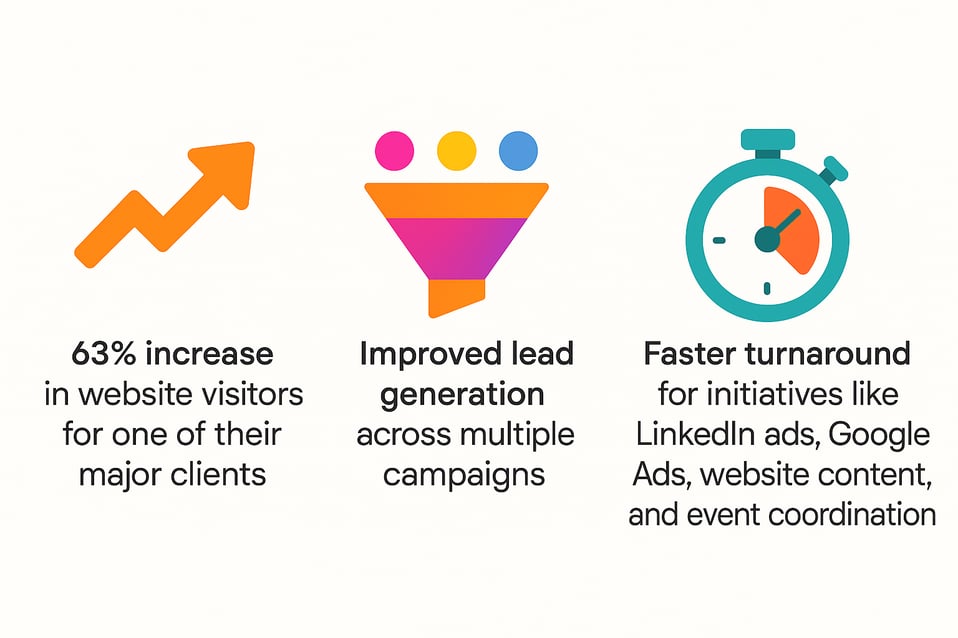
Partnering with Teamified, Infuse Marketing built a creative marketing team in the Philippines. They started small, bringing on a few digital marketing experts and SEO specialists to support campaign execution and strategy.
Within months, they saw tangible results:
Seeing the impact, Infuse Marketing confidently scaled up to a full offshore team that now covers content, design, performance marketing, and digital advertising — all while maintaining cost efficiency and quality.
Infuse Marketing’s experience proves that outsourcing can be a powerful growth lever for marketing teams. By tapping into offshore talent, you gain the capacity to launch more campaigns, test new channels, and execute strategies faster, all while keeping your in-house team focused on big-picture initiatives.
With Teamified, you can build high-performing offshore marketing teams in the Philippines, India, or Sri Lanka, giving your business the flexibility to adapt, the expertise to compete, and the capacity to grow without overextending your local team.
References:
[1] How Australian Marketing Firms Enhance Campaigns with Outsourced Talent (penbrothers.com)
[2] How to Outsource Your Marketing Team in 2025 (marketerhire.com)
[3] Ultimate Guide to Building a Marketing Team Offshore (avada.io)
[4] How Do I Successfully Offshore Marketing Services? (weareamnet.com)
[5] How To Build A Stellar Offshore Creative Marketing Team (forbes.com)
[6] Seeking Offshore Marketing Services, What Are The Pros & Cons? (foundersarm.com)
With over two decades of experience in FinTech, SaaS, and outsourcing, Simon has co-founded multiple successful ventures, including Assembly Payments and Lazu. His deep understanding of technology, payments, and operational efficiency enables him to support businesses in building high-performing outsourced teams while driving cost efficiencies.
Since launching Teamified, Simon has been a trusted partner for companies looking to expand their onshore operations with a smarter, faster, and more strategic approach to outsourcing.